
 Analox
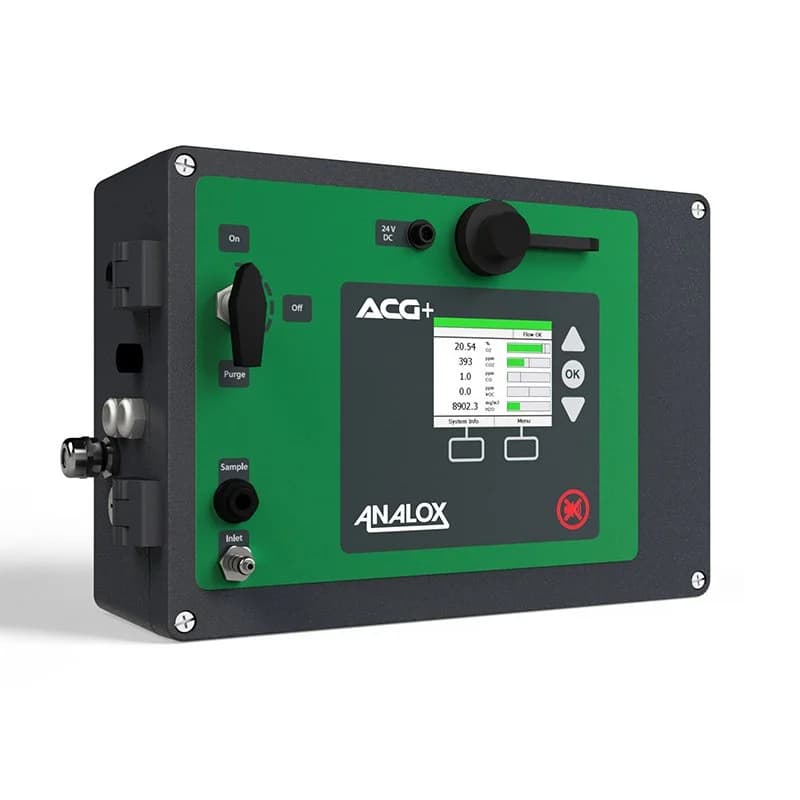
ACG+ Monitor for Compressed Breathing Air
Part no. ACGPAAAAAXXThe Analox Team of engineers and product development specialists created the ACG+ for work in multiple environments, addressing a variety of situations and applications.
Price on requestMake an enquiry →
Quotes returned within one business day. Defence and government pricing available. Got a question first? Make an enquiry.Overview
Say goodbye to fiddly tube tests and expensive lab analysis and say hello to a reliable, accurate monitor which can help you meet EN12021, DEF-STAN 68-284, CGA, CSA and OSHA compliance.
In the highly precise world of compressed breathing air, true professionals demand proven results, consistent reliability along with turnkey installation and maintenance. The Analox team recognises this and has built the ACG+ to answer these challenges.
Key Features
- Provides continuous monitoring 24/7
- Low maintenance and is easy to install and maintain
- Provides 90 days of datalogging which you can easily retrieve via a USB connection
- Cost effective alternative to colourimetric tube testing
- Supplied as either a fixed or portable version depending upon your needs
- Can be used on any breathing air compressor
- Digital display
Applications
- Diving
- Emergency Services
- Manufacturing
- Paint Spraying
- Ships
- Medical
Specifications
ACG+ Unit
Power24V DC
Optional battery powerNiMH or Li-ION
Optional mains adaptorUniversal input 95 to 250 V AC, 50/60 Hz
IP RatingIP45
Response TimeT90 <120 seconds T90 <15 minutes H2O sensor
Temperature Operating−5 °C to 50 °C / 23°F to 122°F Storage: −10 °C to 60°C / 14°F to 140°F
Flow rate0.5L per minute (max)
Inlet Pressure5-10 Bar Gauge (Optional regulator can be purchased)
Humidity0-99% RH (Non Condensing)
Outputs1 x normally open relay contacts 1 x normally closed relay contacts 3 x 24 V DC switched output
ACG+ Sensors
| Feature | O2 Sensor | CO2 Sensor | CO Sensor | VOC Sensor | Water Vapor Sensor |
|---|---|---|---|---|---|
| Range | 0 to 50% | 0 to 1000 ppm | 0 to 20 ppm | 0 to 100 ppm | 0 to 100 mg/m3 |
| Accuracy | ±(0.035% O2 + 1% of reading + ±(0.035% O2 + 1% of reading + 0.15% of reading/°C) | ±(25 ppm CO2 + 1% of reading + 1 ppm CO2/°C) | ±(1 ppm CO + 5% of reading + 0.1 ppm CO/°C) | ±(1 ppm VOC + 5% of reading + 0.25% of reading/°C) | ±(0.15 mg/m3 H2O + 20% of reading) |
| Technology | Analox MEC intelligent electrochemical oxygen sensor | Analox 5S3 intelligent NDIR sensor | Analox MEC intelligent electrochemical sensor | Analox MEC intelligent PID sensor | Water vapour sensor using capacitive technology |
Videos
AU Skip navigation Sign in How to replace the CO sensor on the ACG+
AU Skip navigation Sign in Analox ACG+ Dew Point Replacement Sensor
AU Skip navigation Sign in Analox ACG+ Replace O2 Sensor
AU Skip navigation Sign in How to Install the Analox ACG+ PC Tool
Frequently asked questions
Can the ACG be used to test the quality of breathing air used to protect personnel from hazards posed by a hazardous substance covered by the COSHH regulations?
In part yes, the ACG can measure the quality of breathing air to the standards required for the gasses it measures, O₂, CO₂, CO, VOC’s and H₂O. The required standards listed in the Approved Code of Practice (ACOP 9) are the same as BS EN 12021. Where the risk assessment for a process highlights a gas that is not measured by the ACG. I.e. a hazardous substance used, produces a harmful gas in quantities greater than safe exposure limits, such that it is a danger. Depending upon the gas in question it may be possible to test for the gas using the ACG’s sample support function with a colorimetric tube specific to the gas. If this is not possible then the ACG would not be suitable as the only test method employed under the COSHH regulations.
How often would you suggest I take an oil mist sample at the ACG’s sample support port?
The frequency of routine sample testing depends upon the level of usage of the compressor, how close to the design limits it is used and the scale of impact that contaminated gas would have on the compressed air system to which it is attached. As a minimum we would recommend performing an oil mist sample test at least once every three months, to coincide with the calibration checks of the other sensors in the ACG. Another good practice is to perform an oil mist sample test when the water, CO or VOC sensors alarm as they may be indicating a compressor problem, particularly if the source of the alarming contaminant is not obvious.
Can I use an ACG+ to monitor compressors using synthetic oil?
Because many of the mechanisms that generate oil vapor/mist also generate other contaminants such as VOC’s, CO and water vapor, the ACG+ is suitable for monitoring compressors using both synthetic oil and mineral oil. The ACG+ monitors for these contaminants which, when detected, can give an indication that problems may be present with the compressor (resulting in the generation of oil mist). These indications can be used as a prompt to perform an oil mist test using the sample support feature.
Can I use the sample support port for any type of color metric tube?
Yes, this feature adds flexibility to the user to use a variety of tubes for any type of gas.
How do I replace the CO sensor on the ACG+?
The ACG+ CO sensor should be replaced approximately every 2 years (or as required). This procedure is detailed in the ACG+ user manual.
We also have created an instruction video for this procedure - See video.
How do I replace the dew point sensor on the ACG+?
The ACG+ dewpoint (water vapor) sensor should be factory calibrated/ exchanged every 2 years. This procedure is detailed in the ACG+ user manual. See video
How do I replace the O₂ sensor on my ACG+?
The ACG+ O₂ (oxygen) sensor should be replaced approximately every 2 years (or as required). This procedure is detailed in the ACG+ user manual. See video
How to install the ACG+ PC Tool for the ACG+?
See video